
Favoriten: a guide to Vienna’s 10th district
Favoriten is Vienna’s 10th district, south of the centre, and with more than 220,000 residents one of the most populous in the city. It is not a postcard quarter but a dense, lively working-class and immigrant district with a long pedestrian street, a large food market, the main railway station and wide parks on its southern edge. Almost everything worth seeing is on the U1 underground line.
What kind of district is Favoriten?
Favoriten was created in 1874, when the parts of the 4th and 5th districts lying outside the Linienwall were merged into a new district. Its name comes, by way of Favoritenstraße, from the Favorita palace, today the Theresianum in the 4th district. From the 1860s the northern part grew as a quarter of factories and workers’ housing, and brickworkers from Bohemia and Moravia laboured on the Laaer Berg.
Immigration still shapes the district. According to City of Vienna figures, more than half of its residents are of foreign origin. The streets are dense, loud and everyday: old tenement blocks, shops, market stalls. For palaces, take the U1 into town; to see how Vienna lives away from the Ringstraße, stay here. The overview of where to stay in Vienna compares the districts.
Favoritenstraße, Keplerplatz and Reumannplatz
The pedestrianised stretch of Favoritenstraße is the district’s spine. It was laid out during construction of the underground and opened in 1974; the U1 has run beneath it since 1978. The city has been redesigning the zone and planting trees in two stages since 2025.
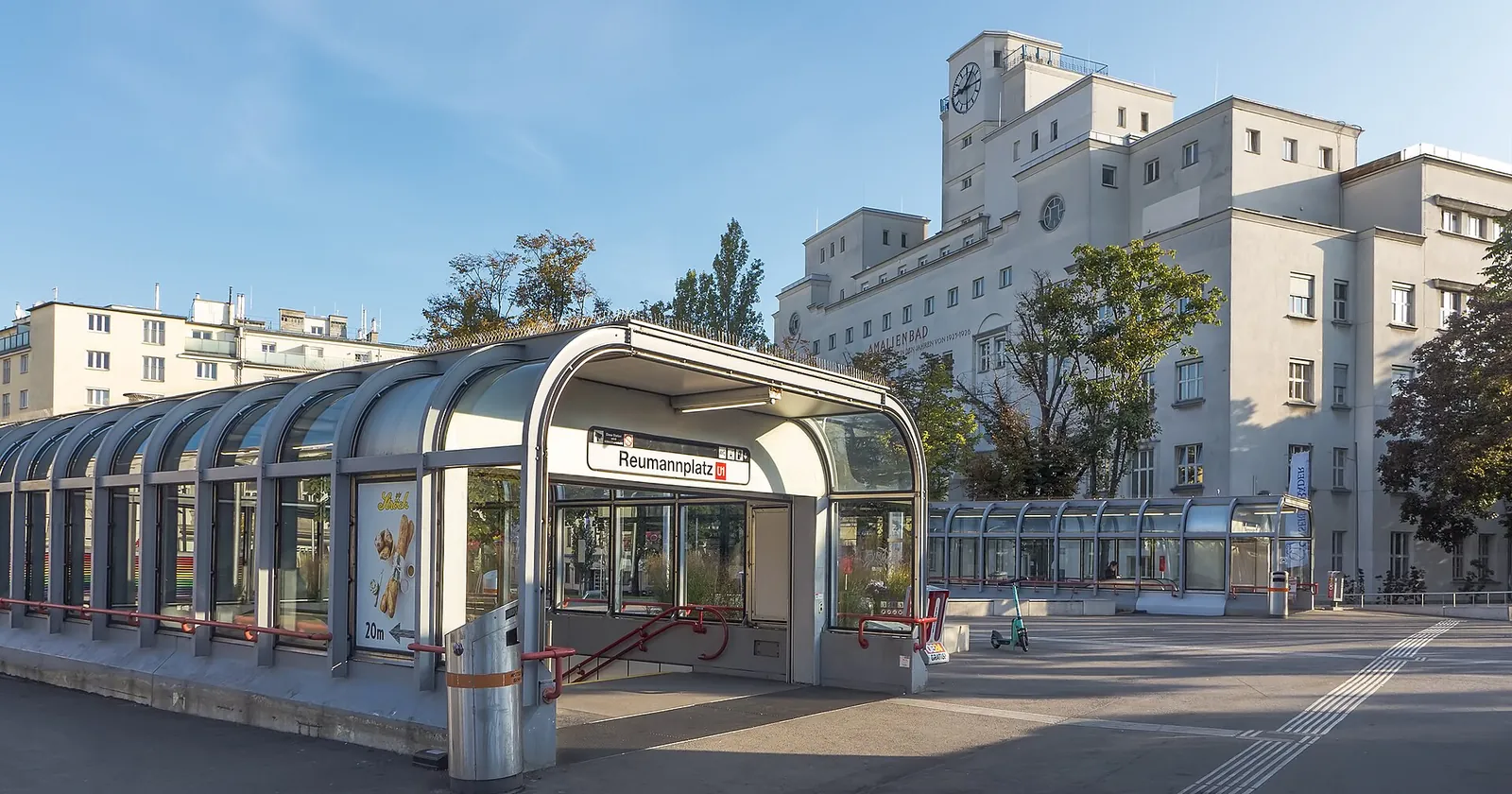
Keplerplatz, named in 1871 after the astronomer Johannes Kepler, has at its centre the twin-towered Keplerkirche, a neo-Renaissance church built between 1872 and 1876. The U1 station of the same name lies directly under the pedestrian zone. At the southern end, Reumannplatz has the Amalienbad, a public bath opened in 1926 with Art Deco interiors, and opposite it the ice-cream parlour Tichy, known for its Eismarillenknödel, apricot dumplings made of ice cream.
The Domenig-Haus: the building that breaks the row
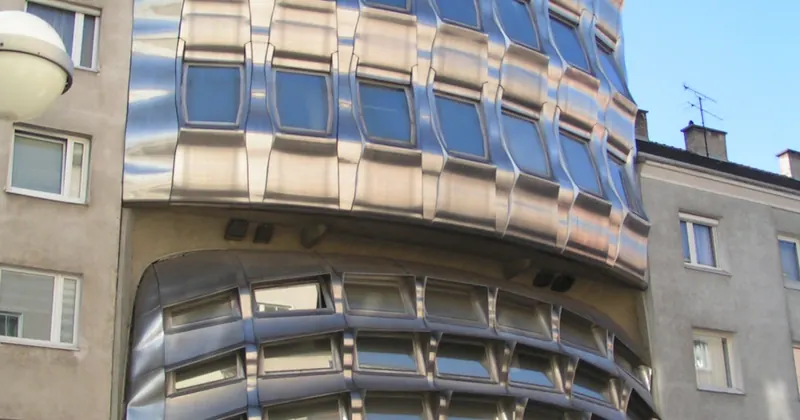
Between Keplerplatz and Viktor-Adler-Platz, at Favoritenstraße 118, one building stands out from the row. Günther Domenig built it between 1975 and 1979 as a branch of the Zentralsparkasse bank. Its curved stainless steel façade looks as if it had been squeezed between its neighbours; Domenig called it the “Haus mit dem Knick”, the house with the kink.
The façade and the first two floors have been a listed monument since October 2005, and the building received the Austrian Bauherrenpreis in 1981. Today it houses Domenig House – Design Apartments. For the architect himself, see the article on Günther Domenig; for more buildings in this spirit, the architecture tour beyond the Ringstraße.
Viktor-Adler-Markt, the “Platzl”
A little further along Favoritenstraße is Viktor-Adler-Markt, known locally as the “Platzl”. Founded in 1877 and extended in 1910, it has carried the name of the Social Democrat Victor Adler since 1919. Stalls sell food of every kind, from fruit and vegetables to meat, fish and bread, and in the mornings a farmers’ market sets up in the adjoining Leibnizgasse. Traders here are known for being loud and direct. The guide to Vienna’s markets compares it with the Naschmarkt and the Brunnenmarkt.
Hauptbahnhof and Sonnwendviertel: the new Favoriten
One U1 stop towards the centre is the Hauptbahnhof, Vienna’s main station, opened in 2014 on the site of the former Südbahnhof. South of it, on the old freight yard, the Sonnwendviertel has been built, a new quarter with around 5,500 flats according to the City of Vienna. At its centre is Helmut-Zilk-Park, roughly 70,000 square metres with playgrounds and an outdoor motor-skills course; the city gives the walk from U1 Keplerplatz as about 600 metres.
The contrast with the older streets around the pedestrian zone is sharp. Routes from the airport and the Hauptbahnhof to Keplerplatz are set out in getting around Vienna.
Green edges: Böhmischer Prater, Kurpark Oberlaa and Therme Wien
The Böhmischer Prater, beside the Laaer Wald, is a small amusement park that grew out of a country inn in the late 19th century and owes its name to the Bohemian brickworkers. It has carousels, a small Ferris wheel and inns, and the Vienna tourist board describes it as calmer than the big Prater. It operates seasonally. Take bus 68A from Reumannplatz to Urselbrunnengasse and continue on foot.
Kurpark Oberlaa was created for the Vienna International Garden Show of 1974. The City of Vienna puts it at around 608,600 square metres, with themed gardens, ponds and a Japanese garden. Next to it is Therme Wien, a thermal spa fed by a sulphur spring. Both are at the U1 terminus Oberlaa, six stops beyond Keplerplatz. Check current opening times before you go.
Quick answers
Is Favoriten a good area to stay in Vienna?
Yes, if fast connections and a real residential district matter more to you than old-town scenery. From U1 Keplerplatz it is four stops to Stephansplatz and one to the Hauptbahnhof. It is not a quiet or polished area.
How do I get from Stephansplatz to Favoriten?
Take the U1 towards Oberlaa. Keplerplatz is the fourth stop after Stephansplatz and Reumannplatz the fifth.
How much time does Favoriten need?
Half a day covers the pedestrian zone, Viktor-Adler-Markt, the Domenig-Haus and the Sonnwendviertel. Allow another half day for Kurpark Oberlaa, Therme Wien or the Böhmischer Prater.
Domenig House – Design Apartments is at Favoritenstraße 118 in the pedestrian zone, with the U1 station Keplerplatz right outside. To enquire about the Rooftop Suite, send a WhatsApp message or call +43 676 5763838.
Sources (30)
Researched: 15 November 2026
- Stadt Wien: 10. Bezirk – Favoriten
- Stadt Wien: Bevölkerung in den Bezirken (Herkunft)
- Wikipedia: Favoriten
- Wien Geschichte Wiki: Favoriten
- Wien Geschichte Wiki: Fußgängerzonen
- Stadt Wien: Favoritenstraße – Fußgängerzone wird umgestaltet
- Wien Geschichte Wiki: Keplerplatz
- Wikipedia: Pfarrkirche St. Johann Evangelist (Wien)
- Wikipedia: U-Bahn-Station Keplerplatz
- Wikipedia: U-Bahn-Linie U1 (Wien)
- Wiener Linien: Haltestellen der Linie U1 Richtung Oberlaa
- Wien Geschichte Wiki: Amalienbad
- Wikipedia: Eissalon Tichy
- Wikipedia: Domenig-Haus
- wien.info: Wiens radikalstes Haus
- Wikipedia: Günther Domenig
- Stadt Wien: Viktor-Adler-Markt, Platzl
- Wien Geschichte Wiki: Viktor-Adler-Markt
- Wikipedia: Viktor-Adler-Platz
- Stadt Wien: Hauptbahnhof Wien – Zahlen, Daten, Fakten
- Stadt Wien: Stadtentwicklungsgebiet Sonnwendviertel
- Stadt Wien: Helmut-Zilk-Park
- Stadt Wien: Motorikpark 10 im Helmut-Zilk-Park
- vienna.info: The Bohemian Prater
- Wikipedia: Böhmischer Prater
- Wiener Linien: Haltestellen der Linie 68A
- ganz-wien.at: Böhmischer Prater (Anfahrt)
- Stadt Wien: Kurpark Oberlaa in Favoriten
- vienna.info: Therme Wien Oberlaa
- Therme Wien: How to reach us
Keep reading
Where to stay in Vienna: which district suits which traveller
Five parts of Vienna compared by what each is good for, from the historic centre to Favoriten on the U1.
Günther Domenig: the architect and the buildings you can see
A short profile of the Austrian architect Günther Domenig, with a list of his buildings that can be seen today.
Radical architecture in Vienna: a tour beyond the Ringstraße
A self-guided route to Vienna’s unconventional modern buildings, starting at the Domenig-Haus in Favoriten.